Part 4 - Assembling the Hardware
The assembling of a permanent observatory either with roof or without, you still require a considerable of equipment. The mount will be the main whereby you would have to build around it.
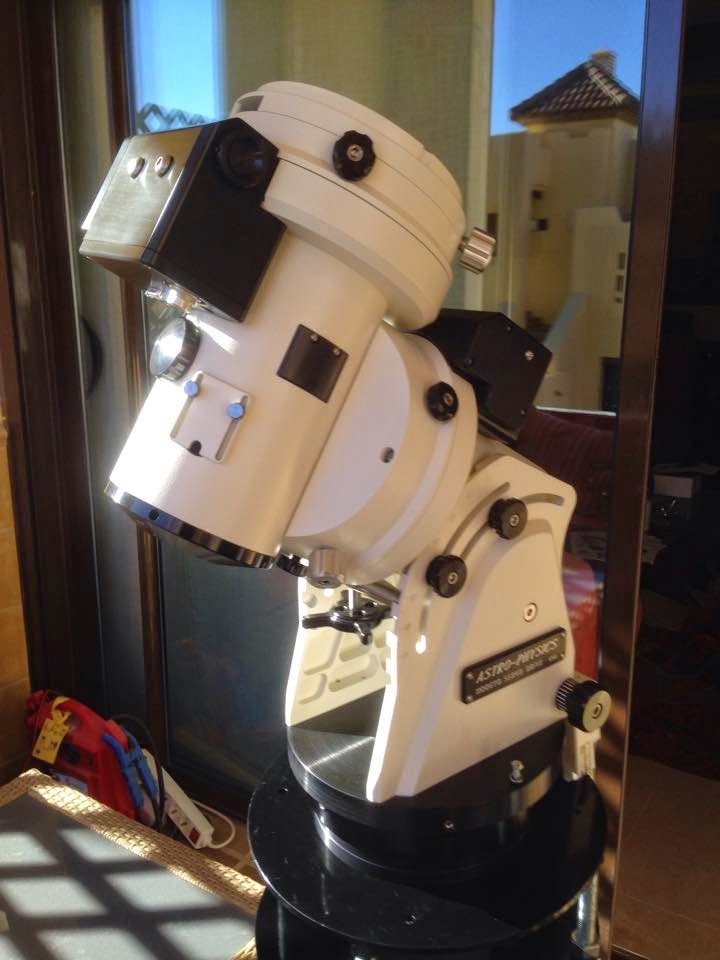 The AP mount 1100GTO is an excellent mount for precision astrophotography. This particular mount does not include the Absolute Encoders. AE are the latest technology in precision guilding.On
axis encoders have many advantages, they should not be considered a panacea for
taking long unguided photos. External factors such as optical tubes that bend
and differential refraction that conspire to degrade pointing and tracking
accuracy cannot be fixed with on axis encoders.
The AP mount 1100GTO is an excellent mount for precision astrophotography. This particular mount does not include the Absolute Encoders. AE are the latest technology in precision guilding.On
axis encoders have many advantages, they should not be considered a panacea for
taking long unguided photos. External factors such as optical tubes that bend
and differential refraction that conspire to degrade pointing and tracking
accuracy cannot be fixed with on axis encoders.
Advantages of on axis encoders:
1. Mount is marginally easier to use by eliminating the need to
initialize the mount's position (through homing or synchronization) at start up
or after power loss.
2. Provides improved pointing and tracking accuracy by
continuously monitoring the position of the main gear, as opposed to an encoder
mounted to the motor's drive shaft.
3. Virtually eliminates errors caused by periodic error as well as
the need to train periodic error.
4. Transparent operation; the on-axis encoder hardware and
electronic sensors are integral to the mount's mechanical design, control
system electronics and control software.
Disadvantages of on axis encoders:
1. Cost. On axis encoder technology is expensive. Not everybody can afford it, although I am sure that everybody would like to have it.
On,y two others mounts provide AE, 10Mircon & APA, apart from these three supplier, I am not aware of any other.

The Mount would need a pier to hold it steady and strongly fixed, I decided on a 8" diameter steel pier with a top movable flange to avoid complication when the mount is fixed on.
This is the top flange with the AP adaptor that will hold the AP mount
I also included a tray for the mount.
Finally the RAPA polar alignment scope.
The final setup with all the units assembled.
Apart from the setup, there are all the bits & pieces that will assist me to control better the mount.
.jpg) |
| The Mount Hub Pro, is an excellent addition to all mounts, it will provide just a single USB cable from the unit to the laptop. From the hub I will connect (input)at least five accessories, like;CCD, AO, Dew Heaters, gilder camera and so on. Instead of having all these units cables running from the pier to the laptop, only one output will be used from the hub. |


